
Experts at a discussion in Delhi emphasised the importance of ethical governance and indigenous capability in India's pursuit of becoming a global artificial intelligence power, ensuring technology serves the public good and maintains strategic autonomy.

Aviation fuel prices for domestic airlines remain unchanged, providing stability for local carriers, while commercial LPG and 5-kg cylinders see a significant rate hike due to rising international energy costs.

Apple CEO Tim Cook's strategic pivot, from initial rejections to local partnerships and leveraging government policies like PLI, transformed India into a major iPhone manufacturing and export hub, now accounting for one in every four iPhones assembled globally.

India successfully test-fired the newly-developed tactical missile Pralay, capable of carrying conventional warheads, from APJ Abdul Kalam island off the coast of Odisha. The missile, developed by DRDO, has a range of 150 to 500 km and a payload capacity of 500-1,000 kg.

The weapon system is customised to operate in altitude above 4,500 metres and has latest upgrades including indigenously developed Radio Frequency seeker, as per the release.

A senior US official has emphasised India's crucial role in maintaining peace and stability in the Indo-Pacific region and ensuring a balanced power dynamic in Asia, advocating for stronger defence ties between the two nations.
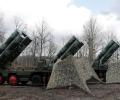
The Indian side would prefer to get S-500 air defence system which has more range than the S-400 but it would require a clearance from the top Russian leadership for its sale, they said.

DRDO conducted the maiden flight test of the Long Range Land Attack Cruise Missile from a mobile articulated launcher.

State-run Hindustan Aeronautics Limited has won a bid under which it will receive technology from the Indian Space Research Organisation for the end-to-end commercial production of the Small Satellite Launch Vehicle (SSLV), a first for the industry as India seeks to become a global hub for small satellite manufacturing and launches.

From the Sensex firms, Adani Ports, NTPC, Power Grid, HCL Tech, Tata Steel, Sun Pharma, Trent and Asian Paints were among the major gainers. However, Bharat Electronics, Eternal, Mahindra & Mahindra and Maruti were among the laggards.

India has called for a ceasefire, release of all hostages, and peaceful resolution of the Israel-Hamas conflict through dialogue and diplomacy. The Centre informed Parliament that India welcomed the agreement on the first phase of the Gaza Peace Plan. The article also covers India's energy sourcing strategy and the release of Indian fishermen by Pakistan.

The system performance was also validated through the data captured by a number of radars, telemetry and electro-optical tracking system deployed by ITR, Chandipur.

"It is high time India traded dynasty for meritocracy. This would require fundamental reforms, from imposing legally mandated term limits to requiring meaningful internal party elections, together with a concerted effort to educate and empower the electorate to choose leaders based on merit," Tharoor said.

Among Sensex firms, Bharat Electronics, Eternal, Mahindra & Mahindra, Kotak Mahindra Bank, Tata Motors and Power Grid were the gainers. However, Adani Ports, ITC, UltraTech Cement and Titan were among the laggards.

The defence minister, without naming anyone, said some people are not liking the rapid development of India and are unable to digest it.

India's economy could reach $20.7 trillion in terms of purchasing power parity (PPP) by 2030 and may emerge as the second-largest economy by 2038 with $34.2 trillion GDP, an EY report said on Wednesday. The report also said that with appropriate countermeasures, India can limit the adverse impact of higher US tariffs on selected Indian imports to about 10 basis points of real GDP growth.

From the Sensex constituents, Adani Ports, Tata Steel, Kotak Mahindra Bank, UltraTech Cement, Bajaj Finserv and Titan were among the biggest gainers. In contrast, Power Grid, Trent, NTPC, Maruti, HCL Tech and Bharat Electronics were among the laggards.

Adani Group has commissioned India's first off-grid 5 megawatt green hydrogen pilot plant in Kutch, Gujarat, the conglomerate said.

The ministry of defence in September 2021 signed a Rs 21,935-crore contract with Airbus Defense and Space SA, Spain for supply of 56 aircraft.

By the time the enemy aircraft is 50 km away, the Akash-NG's computers have calculated the launch trajectory and impact point and launched the missile.

Modi made the comments in his address after inaugurating the 14th edition of Aero India at the Yalahanka Air Force station complex on the outskirts of Bengaluru.

The Enhanced Pinaka has demonstrated a range of 75 km and an ability to strike within 10 metres of where it is aimed. This allows a Pinaka battery to destroy a terrorist camp, or an enemy post, logistics dump or headquarters, without sending soldiers across the border.

The missile has been developed to engage highly fortified enemy tanks in day and night conditions.

The new variant of the Akash missile (Akash-NG) can strike targets at a distance of around 60 km and fly at a speed of up to Mach 2.5.

The five-day event will include aerial displays by aircraft and helicopters along with a large exhibition and trade fair of aerospace and defence companies.

The test was carried out by DRDO against a high-speed unmanned aerial target which was successfully intercepted by the missile.

'If gold's recent surge has increased its allocation beyond 15 per cent in your portfolio, now may be a good time to rebalance.'

The tests were conducted by the Indian Air Force, which will be the first service to induct the Akash missiles in its inventory.

In line with the government's vision of 'Aatmanirbhar Bharat', the ministry of defence on Thursday signed contracts with Indian shipyards for the acquisition of 11 next generation offshore patrol vessels and six next generation missile vessels at a cost of nearly Rs 19,600 crore, officials said.

Singh made the remarks while addressing a "CEOs' Roundtable" at the 14th edition of Aero India at the Yelahanka Air Force station complex on the outskirts of Bengaluru.

Distinguished scientist and Director of Defence Research and Development Laboratory (DRDL), K Jayaraman said Bharat Dynamics Limited, a public sector undertaking under the Ministry of Defence, is currently producing 50-60 indigenously-developed Akash missile per month.

India's defence sector presents an ordering opportunity worth $138 billion between fiscal years 2023-24 (FY24) and FY32, said a latest note by Nomura, which has initiated coverage on two defence-related players - Hindustan Aeronautics (HAL) and Bharat Electronics (BEL) - with a 'buy' rating. The research and broking house sees an upside potential of 28 per cent and 32 per cent, respectively in these two stocks from the current levels.

Describing the trial a "complete success", sources said that all the mission objectives were met during the test.

India on Friday successfully test-fired its indigenously developed nuclear-capable Agni-I ballistic missile with a strike range of 700 km from a test range off Odisha coast as part of a user trial by the army.
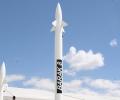
Indian Navy will soon test fire a long-range surface-to-air missile, jointly developed by India and Israel, aiming to enhance its capabilities against incoming missiles, aircraft and drones.

The surface-to-surface missile, powered by solid propellants, was test-fired from a mobile launcher at 10.10 am from launch pad-4 of the Integrated Test Range at Abdul Kalam Island (Wheeler Island), defence officials said.

The missile has a strike range of more than 2,000 km.

Citing lack of evidence, CBI has closed its probe into alleged irregularities in the award of over Rs 575-crore contract in the production of Akash missile system components by top officials of Bharat Dynamics Limited to a private power company.

India on Monday successfully test-fired its indigenously built nuclear-capable intermediate range Agni-I ballistic missile, capable of hitting a target 700 km away, from a test range off Odisha coast as part of a user trial by the Army.
Agni-I missile is equipped with sophisticated navigation system which ensures it reaches the target with a high degree of accuracy and precision.
 © 2026 Rediff.com - Advertise with us - Disclaimer - Privacy Policy - Sitemap - Feedback - About us - Terms of use - Grievances